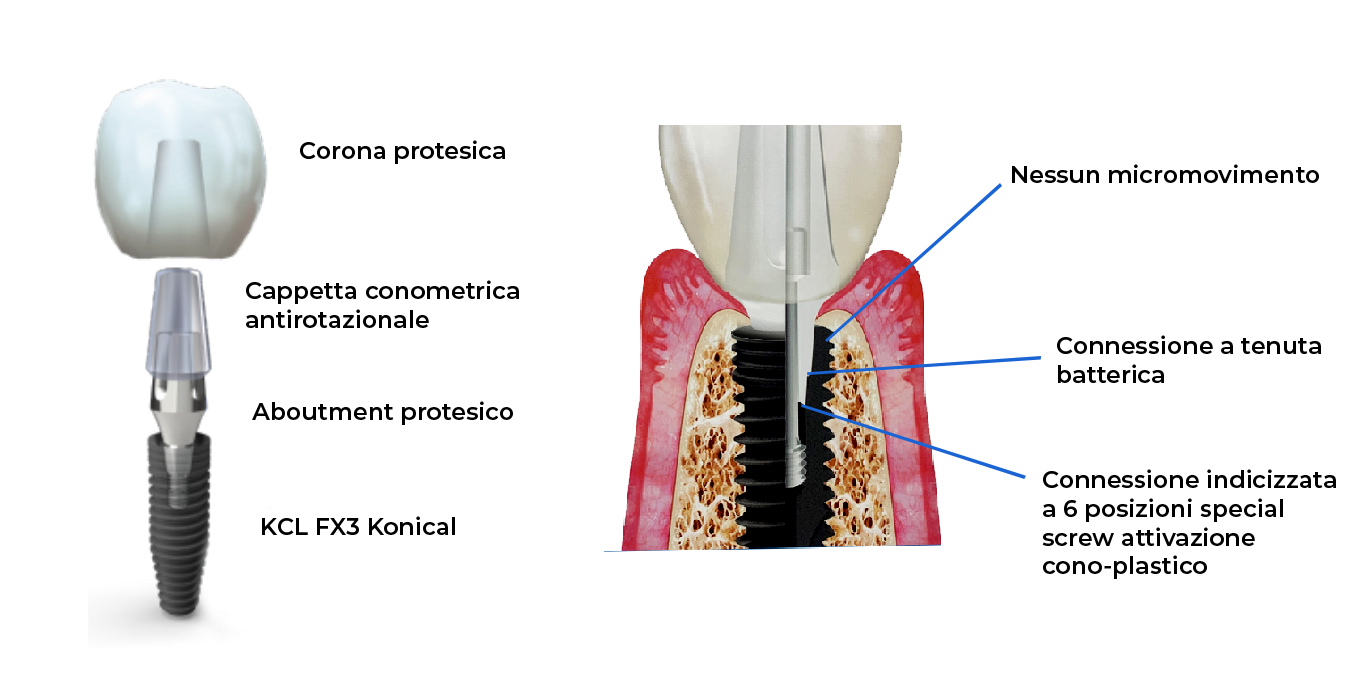
The conometric and anti-rotational connection represents the cutting edge of the ITS implant-prosthetic system, ensuring unprecedented stability between the implant and the prosthetic abutment, comparable to that of a monoblock implant.
Konical is the latest-generation conometric connection—one that is as stable as a monoblock system, yet can be easily disassembled to simplify future repairs. This is made possible by the 5.45-degree angle, which is the extreme limit for what is considered a conometric connection. It certainly requires an integrated screw to establish the connection, but not to hold the components together, as is the case with flat-to-flat connections (and, consequently, this component does not pose the risk of loosening or breaking, as is the case with flat-to-flat systems).
Thanks to platform switching, Konical creates a biological seal that blocks bacterial infiltration while maintaining the stability of hard and soft tissues; for this reason, it can also be described as a cosmetic implant. By taking the necessary care during extraction and preserving the vestibular bone, Konical allows us to provide maximum satisfaction to patients who desire the best possible aesthetic results and the longest-lasting results.
The solution provides:
Maintains the stability of hard and soft tissues over time, preventing bacterial infiltration and reducing the risk of peri-implantitis
The coupling of the transfer cap is significantly more predictable due to the absence of a connecting cord
Since the caps are made of titanium, their closure can be verified through a preliminary X-ray examination.
Increased selection and profiling options in prosthetic angles, with the availability of 10-, 17-, 23-, and 30-degree angles.
Implant macro-grommet technology that is undoubtedly more effective and up-to-date, offering the ability to perform surgical subpreparations to achieve optimal primary mechanical stability.
Elimination of the mounter pre-mounted on the head of the implant fixture, which, when subjected to significant rotational stress, seriously compromises the integrity of the torque-transfer mechanism during implant placement.